
Interactive simulator • Computer use recommended
The Solar System
The Solar System is enormously large as you can see from the image above.
And what if I told you today that you can get DETAILED information about each of the planets that compose it? (INCLUDING THE SUN)
Well then, scroll down (on
smartphone) or read right here below (on PC or
laptop)!
And let's begin our adventure!
The Sun
- Its diameter is a whopping: 1,392,684 km (It could contain 1,300,000 Earths inside it!)
- The temperature reaches: 5,500°C (Celsius in "SCIENTIFIC" terms)
- While its CORE temperature reaches 15 MILLION degrees Celsius, and it is precisely here that nuclear fusion takes place, transforming hydrogen into helium, creating light and heat, which takes 8 minutes to reach our Earth.
- It is composed of:
- 74% Hydrogen
- 24% Helium
- 2% Other Elements
- CURIOSITY: It is a "G2 Yellow Dwarf" type star
Dwarf:
It doesn't mean it's small like in a fairy tale! In
astronomers' language, "dwarf"
simply means that it is a normal star,
in the longest and calmest part of its life. It's like
saying it is a stellar "adult", not
a child nor an elder. Most of the stars we see are "dwarfs".
Yellow:
This is easier: it's its
color! Even if you look closely, its
light is actually white. We see it yellow because of
Earth's atmosphere, which "dirties" colors like a
filter. So "yellow" is the color everyone uses to
describe it.
G2:
This is the level of precision.
Think of stars as ovens: the hotter they are,
the more their light is white or blue. The
colder they are, the more red.
Scientists have ordered them by heat with letters: O, B, A, F, G, K, M.
To remember them, they use a silly phrase that comes from English: Oh Be A Fine Guy Kiss Me!Instead 2 means that it is among the hottest in its "G" category.
Mercury
- Its diameter is 4,800 km, about 38% of Earth's diameter!
- Its distance from the Sun is 58 million km
- Time it takes to rotate once on itself (making a day) is 59 Earth days.
- Instead, the time it takes to complete one orbit around the Sun (making a year) is 88 Earth days.
- Its temperature reaches 430°C during the day, and -180°C at night. It practically has the largest thermal excursion in the entire Solar System.
- CURIOSITY: It is the closest planet to the Sun and the smallest in the Solar System. Moreover, it has no ATMOSPHERE like Earth, so it is full of craters.
Here is an image of Mercury: (If you click on it, on the image, there will be a test dedicated to our Mercury!)

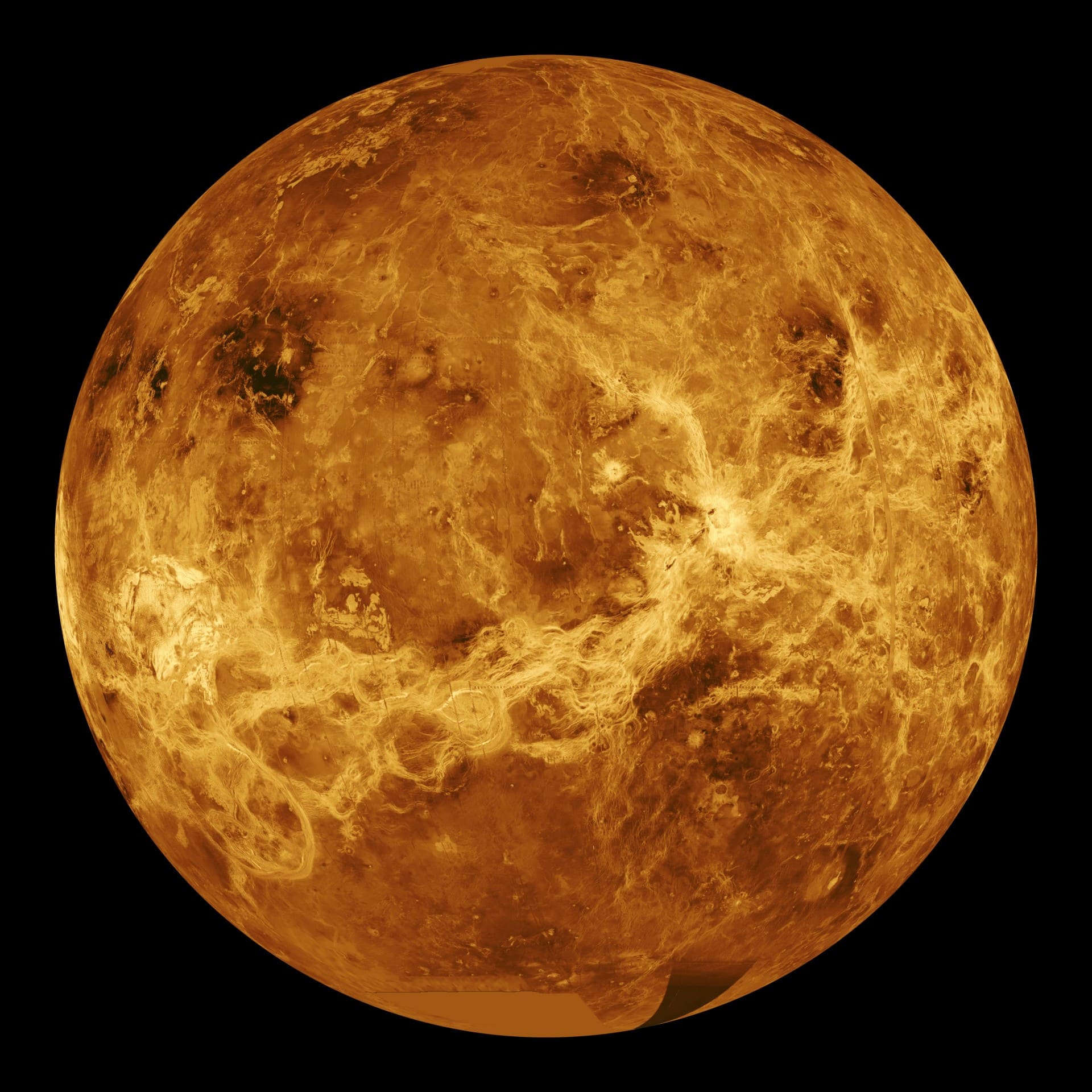
Venus
- Our Venus's diameter is a good 12,104 km, that is 98% of Earth's.
- The distance of this planet from the Sun is about 108 million km.
- The time it takes to make a day, that is one rotation on itself, is 243 Earth days. And think that when it rotates on itself, it spins backwards compared to the other planets!
- Instead to make a year, that is one complete orbit around the Sun, it takes 225 Earth days.
- Its temperature does not vary like Mercury between day and night, and remains practically fixed at 465°C
- CURIOSITY: Its thick atmosphere is made of carbon dioxide which traps heat, in a runaway greenhouse effect. It is the brightest object in the night sky after the Moon.
Here is an image of Venus: (If you click on it, on the image, there will be a test dedicated to our Venus!)
Earth
Earth has a diameter of 12,756 km.
- The average distance from the Sun (AU) is about 150 million km (1 Astronomical Unit).
- The time our dear Earth takes to complete a day, that is the rotation period, is 24 hours (more precisely 23 hours, 56 minutes and 4 seconds).
- Instead the revolution period is 365.25 days, and that's why every 4 years a day is added to February.
- The average temperature is about 15-20°C, but it can reach MAX 50-55°C and MIN -50/-55°C.
- It is the only known planet to have liquid water on the surface and life. Its magnetic field and atmosphere protect us from solar radiation.
- And it has only one natural satellite: the 'Moon'
Here is an image of our dear Earth: (If you click on it, on the image, there will be a test dedicated to our Earth!)

Mars
Mars has a diameter of 6,792 km, about 53.2455% of Earth's.
- Mars takes a good 24 hours and 37 minutes to rotate once on itself, so to make a day it takes almost the same time as Earth!
- And a year on Mars lasts 687 Earth days, almost 2 years.
- On its surface, the temperature varies, depending on the places, for example:
📍 On equatorial craters: +20°C during the day
📍 On sun-exposed slopes: up to +27°C
📍 And in tropical zones: averages of -30°C (manageable)
📍 Equatorial nights: -50°C (to consider)
But the average temperature is about 20°C in habitable zones (more at the equator), and -63°C in the rest of the planet.
- It has 2 natural satellites: PHOBOS and DEIMOS.
- CURIOSITY: It has seasons that are longer compared to Earth's, has polar caps of dry ice (CO2) and water, and the largest volcano in the solar system, Olympus Mons, which is about 25 km high.

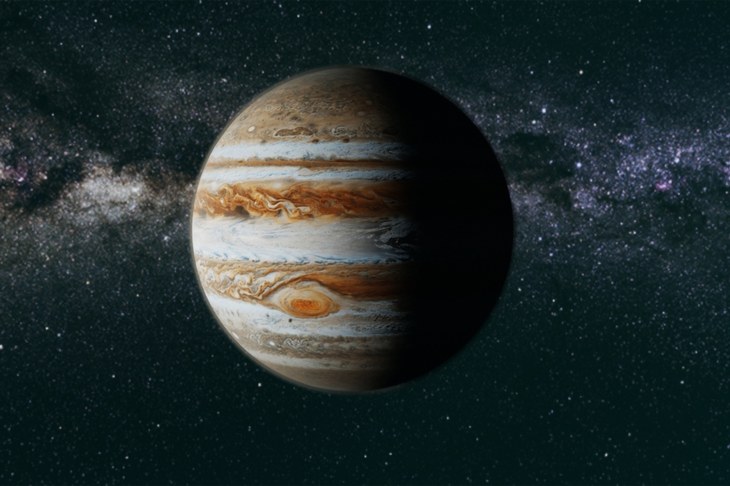
Jupiter
Jupiter has a "double" diameter because on the Equator it has one and on the Pole it has another!
1. East-West Axis (Equatorial Diameter): 142,984
km. It is the straight line that crosses the
planet
from one point of the equator to the opposite.
2. North-South Axis (Polar Diameter): 133,709
km. It is the straight line joining the North
Pole to the
South Pole.
- Jupiter's distance from the Sun is 778 million km (5 times the distance between Earth and the Sun).
- The time it takes to rotate once on itself is about 10 hours and to be precise a day lasts 9 hours 55 minutes and 30 seconds.
- The revolution period around the Sun is almost 12 Earth years, precisely a good 4333 days 14 hours 8 minutes and 38 seconds!
- Its average temperature in the upper clouds is about -145°C.
- It is a gas giant, composed mainly of hydrogen and helium, and has no solid surface.
- It has 95 known moons (including the famous Galilean moons: Io, Europa, Ganymede and Callisto).
Here is an image of Jupiter: (If you click on it, on the image, there will be a test dedicated to Jupiter! [Test still under creation])
Saturn
Saturn also has 2 diameters like Jupiter!
- 1. East-West Axis (Equatorial Diameter): 120,536 km
- 2. North-South Axis (Polar Diameter): 108,728 km
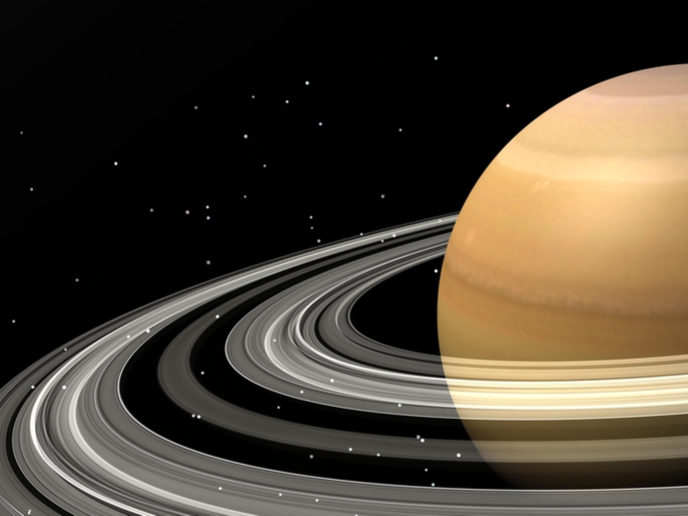
- Extension of the rings: If we also count its main rings, the overall diameter of the visible planet reaches about 282,000 km, but their average thickness is incredibly thin, often just 10 meters.
- The distance from the Sun is about 1.4 billion km, that is almost 10 times the distance between Earth and the Sun.
- Saturn's rotation period is similar to Jupiter's, in fact it lasts just over 30 minutes: 10 hours and 38 minutes.
- To complete one full orbit around the Sun, Saturn takes almost 30 Earth years, WELL over 10,750 Earth days to make a single turn around our Star.
- The temperature here is much colder than Jupiter, in fact the temperature can drop suddenly anywhere, from -140°C to -180°C
- CURIOSITY:
1. It could float in a giant bathtub!
Saturn is composed almost entirely of hydrogen and helium and is the least dense planet in the entire Solar System. Its average density is lower than that of water (about 30% less): if there existed a pool large enough to contain it, Saturn would not sink, but would float like a polystyrene ball.
2. It is the undisputed king of moons (and we keep discovering new ones).
Although famous for its majestic rings of ice and rock, Saturn also holds the absolute record for natural satellites in the solar system. Thanks to continuous discoveries by astronomers, its official count has reached the record number of 293 confirmed moons brutally beating Jupiter. Among these there is Titan, a huge moon larger than the planet Mercury and endowed with a dense atmosphere.
Here is an image of Saturn: (If you click on it, there will be a dedicated test! [test under creation])
Uranus
Uranus Data:
- Equatorial diameter: 51,118 kilometers
- Polar diameter: 49,946 kilometers
- Distance from the sun: 2.87 billion km
- Length of a day: 17 hours and 14 minutes
- Length of a year: 84 Earth years (more than 42,500 Earth days)
- Temperature (both day and night): -220°C
Why do day and night have the same temperature?
- Distance from the Sun: The Sun is so far away that its heat is almost imperceptible.
- Dense atmosphere: Strong planetary winds distribute the cold evenly across the entire planet.
- Lack of internal heat: Unlike Jupiter and Saturn, Uranus does not generate heat from its core, making it the coldest planet in the solar system.
1. It rotates "lying" on its side
All the planets spin like almost vertical tops with respect to the Sun. Uranus, on the other hand, has an axis inclination of 98 degrees: it basically rolls on its orbital plane. This strange position means that for half a "Uranian" year one pole is constantly illuminated by the Sun (perpetual summer), while the other pole remains in complete darkness (perpetual winter).
2. It literally rains a sea of diamonds
The extreme pressure and very high temperatures deep in the atmosphere break down methane molecules. The carbon atoms join together crystallizing into real diamonds, which fall towards the planet's core as if it were a precious rain.
3. It smells like rotten eggs
The upper clouds of Uranus's atmosphere are mostly made up of hydrogen sulfide. This is the exact same chemical that gives rotten eggs their unpleasant, pungent smell. If you could smell Uranus's atmosphere, the odor would be unbearable.
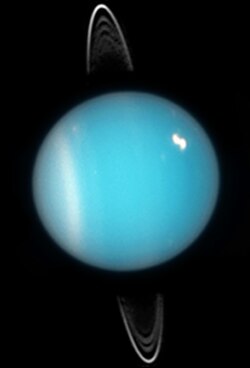
Uranus has rings too, but they are vertical! Let me explain everything to you carefully below: 👇
Why are they vertical?
- A planet's rings always form around its equator. As we saw earlier, Uranus is "lying" on its side with an inclination of 98 degrees. Consequently, its equator and its entire system of rings (and moons) are also rotated vertically with respect to the plane of the solar system.
- When we look at Uranus from Earth, its rings don't surround it "from left to right" like Saturn's, but frame it from top to bottom, like a giant target or the crosshairs of a telescope.
What are they made of? (Small, narrow and invisible)
You remembered very well: they are much smaller, thinner and less flashy than Saturn's.
- Invisible to the common telescope: Saturn's rings are made of bright water ice that reflects the Sun's light. Those of Uranus, on the other hand, are composed of dark rocks, dust and frozen organic material. They are so black that they reflect only 1% of the light they receive.
- Paper-thin blades: The main rings are narrow, often only a few kilometers wide (compared to Saturn's groupings which are tens of thousands of kilometers wide), and are separated by wide empty spaces.
How did we discover them if they are black?
- They were not discovered by looking at them directly, but by pure chance in 1977 thanks to a phenomenon called stellar occultation.
- Astronomers were observing a distant star as Uranus passed in front of it. Before the planet covered the star, the star's light began to "blink" and go out for brief moments. The same happened immediately after the planet had passed. Scientists realized that what temporarily blocked the star's light were thin, invisible rings surrounding the planet.
- Today, advanced telescopes like the James Webb manage to photograph them regularly in the infrared, showing them in all their vertical splendor.
Here is an image of Uranus: (If you click on it, there will be a dedicated test! [Test under creation])
⚠️⚠️⚠️⚠️ DISCLAIMER: OTHER PLANETS WILL BE ADDED OVER THESE DAYS ⚠️⚠️⚠️⚠️
⚠️⚠️⚠️⚠️ URANUS COULD BE ADDED BY 8 SEPTEMBER ⚠️⚠️⚠️⚠️

